Introduction
Dr. Sumait Hospital presents a rare clinical case involving a 70-year-old female patient who experienced chronic chest tightness and progressively worsening shortness of breath (dyspnea). Her case highlights the importance of accurate diagnostic imaging, careful clinical evaluation, and expert surgical intervention in identifying conditions that may mimic heart and lung diseases.
 The patient’s diagnostic journey involved several investigations and initial diagnoses before the underlying condition, known as Morgagni hernia, was identified and successfully treated at Dr. Sumait Hospital.
The Diagnostic Challenge
The patient initially received treatment for bronchial asthma using standard respiratory therapies. However, her symptoms did not improve, prompting further medical investigations to identify the cause of her persistent respiratory difficulties.
Due to concerns about a possible pulmonary embolism (PE), a CT Pulmonary Angiogram (CTPA) was performed to rule out this potentially serious condition. Anticoagulant therapy was also briefly initiated during the diagnostic process.
Further cardiac investigations were conducted, including an Echocardiogram (Echo) and a Cardiac CT Angiogram. Both investigations revealed results within normal limits, making a primary cardiac explanation for her symptoms less likely.
Meanwhile, imaging identified a mass near the heart, known as a paracardiac mass. This finding initially raised concerns about a possible tumor or lipoma, adding complexity to the diagnostic process.
These findings demonstrated the challenges involved in distinguishing Morgagni hernia from other conditions affecting the cardiopulmonary system.
 The Turning Point at Dr. Sumait Hospital
A significant breakthrough occurred when the patient underwent a second, targeted CT scan at Dr. Sumait Hospital. Unlike the earlier interpretation, the new imaging findings strongly suggested that the paracardiac mass was a Morgagni hernia rather than a tumor.
Morgagni hernia is a relatively rare type of diaphragmatic hernia that occurs through an opening in the diaphragm. Depending on its size and the structures involved, it may present with respiratory symptoms and imaging findings that resemble other chest conditions.
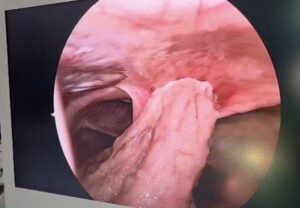
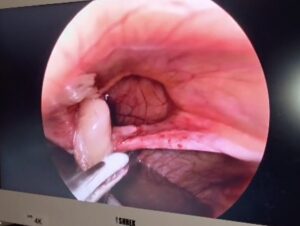
To establish the diagnosis definitively, the medical team proceeded with an exploratory laparoscopy. The procedure confirmed the presence of a diaphragmatic defect consistent with Morgagni hernia.
This case illustrates the importance of reassessing unusual imaging findings and using appropriate diagnostic procedures when a patient’s symptoms do not respond to initial treatment.
Surgical Management and Successful Outcome
Following confirmation of the diagnosis, the patient underwent a laparoscopic hernia repair, a minimally invasive surgical procedure performed through small incisions.
The operation was highly successful, and the patient tolerated the procedure exceptionally well. Most importantly, her respiratory symptoms resolved immediately and completely following surgery.
Her postoperative recovery progressed well under the supervision of the hospital’s medical team, including the general doctors, intensive care team, and surgical ward staff.
Following an excellent postoperative course, the patient was safely discharged home on Post-Operative Day 4 (POD 4).
The successful outcome highlights the value of accurate diagnosis, appropriate surgical management, and coordinated postoperative care in achieving positive patient outcomes.
The Medical and Surgical Team
This successful outcome was made possible through the expertise, dedication, and collaboration of the medical and surgical team at Dr. Sumait Hospital.
Surgical Team
Dr. Tarek Fahed Aljammal
Consultant General and Laparoscopic Surgery
Dr. Tarek Fahed Aljammal led the surgical management of the case, performing the laparoscopic hernia repair that successfully addressed the patient’s condition.
Anesthesia and Intensive Care
Dr. Tsegay Gebremichael Gebremariam
Specialist in Anesthesia and Intensive Care
His specialist role supported the safe delivery of anesthesia and perioperative care throughout the surgical process.
Surgical Assistants and Operation Theatre Team
- Ahmet Omer — Head of the Operation Theatre Department
- Abdisalam A. Mohamed
- Amira Hilolwe Omar
- Mohamed Gashin Mudei
The collaboration of the surgical, anesthesia, and operation theatre teams contributed to the successful management of the patient.
Special Thanks and Acknowledgments
Dr. Sumait Hospital extends its deepest gratitude to all the General Doctors, the Intensive Care Unit (ICU) team, and the Surgical Ward staff for their dedicated monitoring and follow-up care throughout the patient’s postoperative recovery.
The hospital also expresses its sincere appreciation to the Administration of Dr. Sumait Hospital and SIMAD University for their continued support and for providing the advanced infrastructure necessary to deliver high-quality patient care.
Their collective commitment to clinical excellence, teamwork, and patient safety remains essential to the delivery of effective healthcare services.
Conclusion
This rare case of Morgagni hernia demonstrates how a condition that mimics cardiopulmonary disease can present significant diagnostic challenges. The patient’s journey—from initial treatment for bronchial asthma and investigations for pulmonary embolism and cardiac disease to the identification and surgical repair of Morgagni hernia—emphasizes the importance of accurate diagnostic imaging, careful clinical reassessment, and specialist surgical expertise.
The successful laparoscopic repair, complete resolution of respiratory symptoms, and discharge on postoperative Day 4 reflect the importance of coordinated multidisciplinary care.
Through cases such as this, Dr. Sumait Hospital continue to demonstrate their commitment to advancing medical practice, strengthening surgical services, and providing quality, patient-centered healthcare in Somalia.
Dr. Sumait Hospital
Quality Care | Education | Research